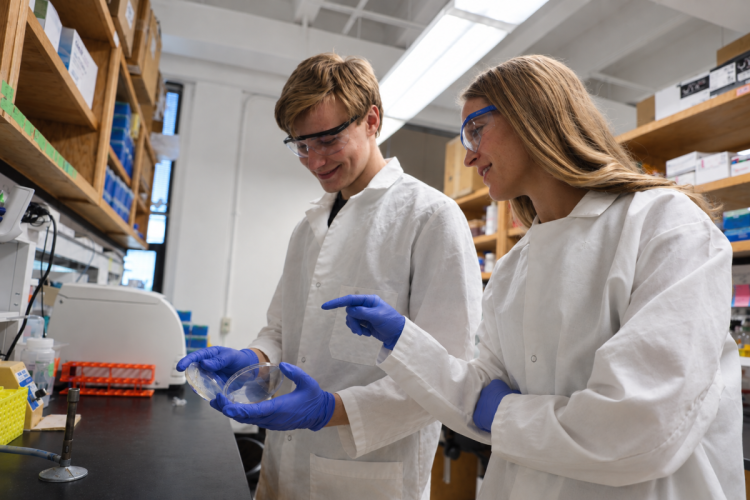
Archer Stone, a junior biological sciences major, has been part of Caroline Grunenwald’s lab for nearly two years.
Caroline Grunenwald, assistant professor of biological sciences, has received an R35 National Institute of General Medical Sciences (NIGMS) Maximizing Investigators’ Research Award (MIRA). The highly competitive award provides long-term, flexible funding for outstanding early-career researchers, allowing them to pursue promising new research directions as discoveries emerge and invest in their trainees, helping prepare the next generation of researchers and innovators.
“Research doesn’t always follow the path you expect, and some of the most interesting discoveries come from unexpected results,” said Grunenwald, whose lab studies methicillin-resistant Staphylococcus aureus (MRSA), a bacterium resistant to antibiotics. “Because this award supports my overall research program instead of a single narrowly defined project, it gives my lab the freedom to pursue promising new directions as they emerge.”
That flexibility comes at a critical time. As antibiotic-resistant infections continue to pose a growing public health threat, Grunenwald’s research team is working to identify targets for drug development and uncover new ways to prevent and treat bacterial infections that no longer respond to existing antibiotics.
Grunenwald credits the College of Arts and Science’s Office of Research and Creative Activities (ORCA) with helping her complete the competitive application.
“Being my first NIH submission, I relied on ORCA throughout the process,” said Grunenwald. “It made the process much less painful than if I had navigated the submission on my own.”
Interested in learning more about R35 MIRA grants and how to start the application process? Contact ORCA.
Grunenwald joins a distinguished group of A&S researchers whose R35 NIGMS MIRA-funded projects advance discoveries in fields ranging from biomedical sciences to computational biology.
Shi-Jie Chen, Curators’ Distinguished Professor, Physics and Astronomy
Project title: New methods for computational modeling of RNA structures
Project summary: Quantitative modeling of RNA folding has a far-reaching impact on RNA based and RNA-targeted disease prevention and therapeutics. Recent advancements in machine learning and the ever-increasing data from RNA-based technologies have now positioned us to develop powerful computational tools and make significant breakthroughs in understanding, modeling, and designing RNAs. These new tools will provide a foundation for the designs of mRNA vaccines, antiviral drugs, and CRISPR genome editing.
Sachin Handa, Associate Professor, Chemistry
Project title: New Catalytic Technologies Impactful to Synthesis of Pharmaceuticals
Project summary: Active pharmaceutical ingredients (APIs) are vital for public health; however, the synthesis of these compounds, particularly for new chemical entities, often demands considerable resources, which can hinder future drug discovery and adversely affect human health. This situation places additional strain on budgets and can stifle innovation; as such, there is an urgent need to develop highly efficient technologies that provide effective and affordable access to pharmaceuticals. This research offers valuable strategies to acquire functional pharmaceutical molecules, thereby improving access to essential chemicals and APIs, ultimately promoting human health.
Kristin Hutchins, Associate Professor, Chemistry
Project title: Controlling drug crystallization, polymorphism, and physicochemical properties using mechanochemistry
Project summary: Our research program uses a combination of synthetic and characterization methods to understand how the solid-state structure of drug molecules leads to function. The drugs we investigate typically exhibit non-ideal properties or controlling their solid form is challenging. By understanding the influence of solid-state structure on function, our research program will develop strategies for controlling or modifying structures and enhancing drug properties as a path toward improving disease treatments.
Elizabeth King, Associate Professor, Biological Sciences
Project title: Genome evolution across complex trait hierarchies
Project summary: Precision medicine promises to customize medical care to the individual patient based on their genome and individual environment and behaviors. However, we lack a basic understanding of the causal connections between the genome and complex trait hierarchies, in which a suite of sub-phenotypes all contributes to produce a high-level phenotype. This research will use a model system to provide general insights into trait hierarchies, with relevance to many health-related trait hierarchies, such as coronary artery disease, exercise endurance, or metabolic syndrome.
Gavin King, Professor, Physics and Astronomy
Project title: Advancing mechanistic understanding at membrane interfaces
Project summary: An increasingly severe threat, fungal infections affect approximately 25% of the world’s population and kill more than 1 million people each year. Disruption to the machinery that directs proteins to membranes is also a major health concern as it leads to neurodegenerative diseases and cancer. The acquisition of fundamental scientific knowledge is required to improve molecular level understanding of these ailments and to rationally design therapeutics to prevent and remedy them.
Maria Mills, Assistant Professor, Physics and Astronomy
Project title: Coordination of complex dynamics by DNA manipulating enzymes
Project summary: The biomolecular processes responsible for maintaining the integrity of DNA often require the coordinated movements of multiple components. To fully understand such processes, it is necessary to probe multiple aspects of protein and DNA motion, ideally at the same time. This project would use a combination of single molecule force and fluorescence measurements, supplemented with computational simulations, to explore the complex behavior of two systems related to genome maintenance and DNA repair: human transcription factor IIH and the type IA topoisomerases of mycobacteria.
Victor K. Outlaw, Assistant Professor, Chemistry
Project title: New orthogonal strategies for chemoselective peptide macrocyclization
Project summary: Although peptides are ideal candidates to modulate protein function and disrupt protein-protein interactions, rapid enzymatic degradation limits their biological applications. Cyclic peptides offer the potential to enhance in vivo stability, while often increasing binding affinity and membrane permeability, leading to more effective therapeutics. The proposed research will enable selective production of new classes of cyclic peptides that will expedite the discovery and optimization of bioactive peptide therapeutics.
Sen Xu, Associate Professor, Biological Sciences
Project title: Understanding the origin of parthenogenesis
Project summary: Investigating the genetic basis of parthenogenesis (i.e., reproduction without sex) will provide insight into the genetic regulation of meiosis that plays a central role in sexual reproduction. Using cutting-edge genomic technologies, Xu’s project examines the evolutionary and genetic mechanisms responsible for the origin of parthenogenesis in the freshwater microcrustacean Daphnia. The outcome of this project will lead to novel understanding of animal reproduction.
Xiaoqin Zou, Curators’ Distinguished Professor, Physics and Astronomy; Biochemistry, College of Agriculture, Food and Natural Resources
Project title: Integrative approaches for predicting protein interactions and applications
Project summary: The accurate prediction of protein interactions is essential for unraveling the mechanisms underlying numerous biological processes and for the development of targeted therapeutics. In this proposal, we aim to address the pressing need for novel computational tools that can predict interactions involving disordered proteins, facilitate silico peptide screening, and more. Our goal is to leverage these advancements to identify and explore potential peptide-based treatments for diabetic wound healing.